 Ahsan Ali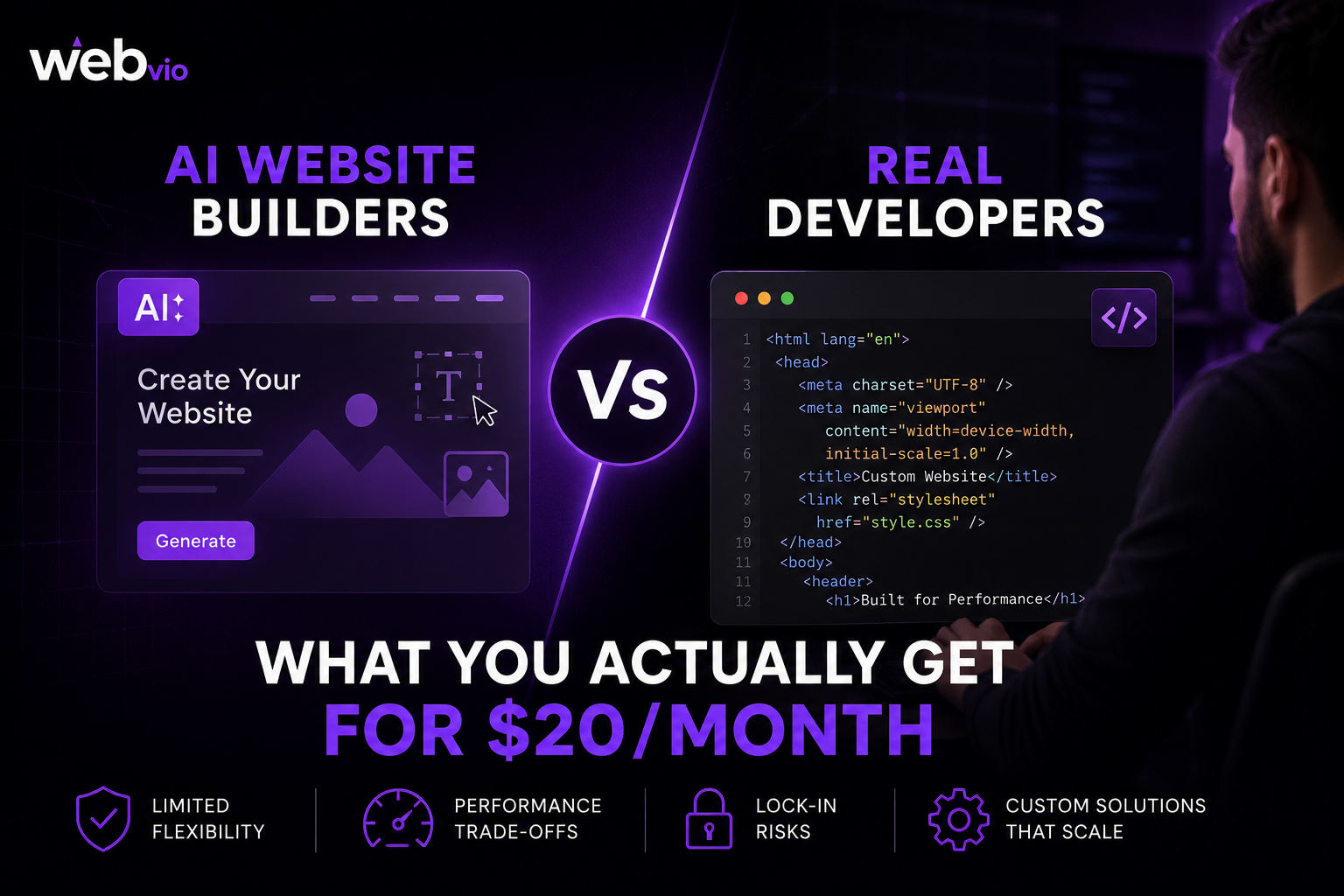
You see the ads on every platform. Type a prompt, get a website in 60 seconds. Pay $20 a month instead of a few thousand upfront. The pitch sounds built for a small business owner watching every dollar.
The ads leave out the parts you feel six months later. This post shows you both sides with real numbers, so you pick based on facts.
The Test We Ran
We took one business brief and built it two ways.
The brief: a local service company needs a homepage, three service pages, an about page, and a working contact form. The company wants to rank for local searches and turn visitors into booked calls.
First, we ran the brief through a popular AI website builder. Then we compared the output to a custom-built WordPress site for the same brief. Same content. Same goal. Two different results.
Result 1: Page Speed and Code Weight
Speed decides whether a visitor stays. Google reports the odds of a bounce rise 32% as page load time goes from one second to three seconds. Slow sites lose visitors before the page finishes loading.
The AI builder produced 4.2MB of page weight for a five-page site with no custom features. It loaded template code, unused scripts, and a page builder engine on every page. First load clocked in at 4.6 seconds on a standard connection.
The custom site delivered the same content in 900KB. It loaded in 1.7 seconds. Every line of code served the pages you asked for. No unused template features. No bloated builder engine running in the background.
The gap: the custom site loaded almost three times faster with a fifth of the weight.
Result 2: SEO Foundation
A website ranks when search engines read its structure cleanly. The two builds handled this differently.
The AI builder auto-generated title tags and meta descriptions with no keyword strategy. The homepage title read “Home.” Two service pages shared the same meta description. The heading structure jumped from H1 to H4 in three places, which confuses how search engines map your content. No schema markup. No control over the sitemap.
The custom site set a keyword-targeted title on every page. Each meta description matched the page intent. Headings ran in order: one H1 per page, H2s and H3s nested underneath. Local business schema told Google the company name, address, and service area. A clean sitemap listed every page for indexing.
One site exists online. The other site was built to rank.
Result 3: Custom Functionality
Business websites need features tied to how you sell. This is where AI builders hit a wall.
The brief called for a multi-step quote form. The form asks the visitor two questions, then shows a price range based on the answers. Standard need for a service business.
The AI builder offered a basic contact form with name, email, and message. No logic. No branching. To get the quote feature, you install a third-party plugin, pay its monthly fee, and accept its limits.
The developer built the multi-step form into the site. It branches on the visitor’s answers, calculates a range from your pricing rules, and emails you the lead with all the details attached. It does what your business needs, not what a template allows.
Result 4: Ownership
Read the fine print on any AI builder plan. You rent the site. You do not own it.
Your $20 a month keeps the site online. Stop paying and the site goes dark. You cannot export clean code and move it elsewhere. You cannot hand it to another developer to extend. The builder owns the platform, and you pay rent for as long as you want to stay online.
A custom WordPress site belongs to you. You own the code, the files, and the database. You host it where you want. You hire any developer to work on it. The site stays yours whether or not you keep working with the person who built it.
The Real Cost Over Three Years
Month to month, the AI builder wins on price. Over three years, the math shifts.
| Factor | AI Builder | Custom Development |
|---|---|---|
| Upfront cost | $0 to $50 | $1,500 to $5,000+ |
| Monthly cost | $15 to $40, forever | Hosting only, $5 to $20 |
| Page load speed | 3 to 5+ seconds | Under 2 seconds |
| SEO foundation | Weak, generic | Built for your keywords |
| Custom features | Limited or blocked | Fully custom |
| Ownership | Rented | Owned |
| 3-year total | $540 to $1,440 | $1,680 to $5,240, one time |
At the low end, three years of AI builder fees reach $1,440 and you own nothing. A custom build costs more upfront, but the fees stop. Year four and beyond, you pay hosting alone. The rented site keeps charging you forever.
Where AI Builders Make Sense
AI builders solve real problems for the right job. Use one when:
- You test an idea you have not validated yet and want a page live today
- You build a personal portfolio with no lead or sales goals
- You need a temporary event page you delete in 30 days
In these cases, speed beats ownership and SEO. The AI builder does the job.
Where AI Builders Cost You
The calculation flips when your website drives your business. Use a developer when:
- Customers find you through Google and you need to rank
- Your site needs booking, quoting, or payment features tied to your rules
- Speed and first impressions affect whether visitors trust you
- You want to own your site instead of renting it
A slow, generic, rented site works against you in each of these cases.
The Question to Ask Yourself
Do you want a website that exists, or a website that works?
An AI builder gets you online fast and cheap. A custom build gets you a site engineered to load fast, rank on Google, and turn visitors into customers. The $20 a month feels small until you add three years of rent for a site your business outgrows in one.
Your website is the first impression most customers get. Decide what that impression is worth before you pick the cheaper monthly bill.
Get a Site Built to Work
Webvio builds custom WordPress sites engineered for speed, search rankings, and conversions. You own the code. You get the features your business runs on. Contact us to talk through your project.