 Ahsan Ali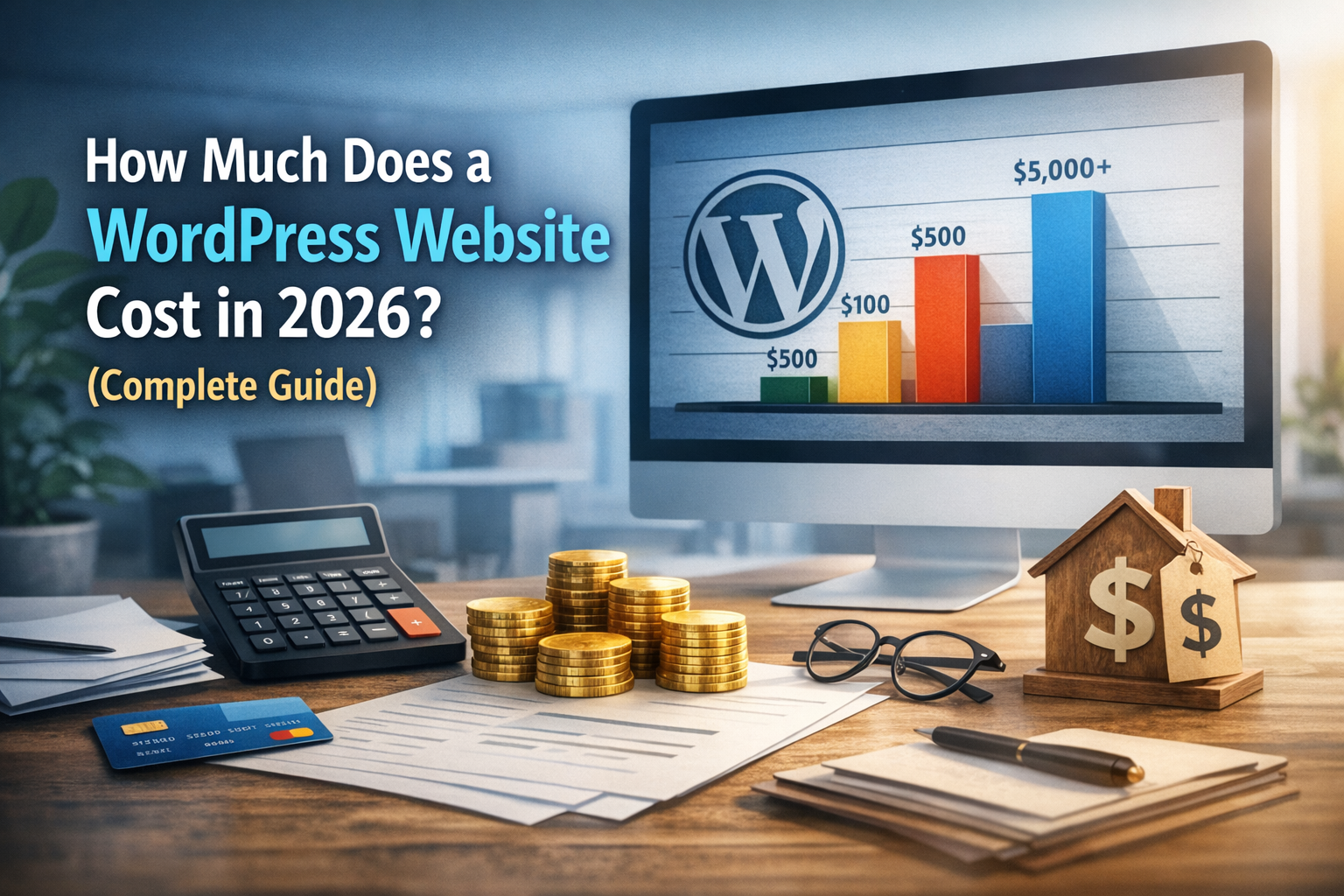
If you’re planning to build a WordPress website in 2026, pricing is probably your first question — and also one of the most confusing ones to answer. Search online and you’ll find quotes ranging from $50 to $50,000 for what appears to be the same thing. How can the gap be that wide?
The answer is that “WordPress website” covers an enormous range of products. A five-page site built on a free theme by a freelancer on Fiverr and a custom-coded conversion-focused business website built by a professional agency are both technically WordPress websites — but they’re completely different products with completely different outcomes for your business.
This guide breaks down real WordPress website pricing in 2026, what you actually get at each price point, and how to decide what level of investment makes sense for your business goals.
Basic WordPress Website — $300 to $1,500
At the entry level, you’re typically getting a site built on a pre-made premium theme with customized colors, fonts, and content. Most basic WordPress builds include 4–6 pages (home, about, services, contact), a contact form, basic mobile responsiveness, and minimal performance optimization.
This type of site is usually built by a freelancer or a small agency using page builders like Elementor or Divi on top of a purchased theme. The upside is low cost and relatively fast delivery — typically 1–2 weeks. The downsides are significant: pre-made themes are used by thousands of other websites, they tend to be bloated with features you don’t need, they load slowly compared to custom-built sites, and they offer little differentiation from your competitors.
A basic website at this price point is appropriate for personal projects, very early-stage businesses that just need an online presence, or businesses in markets where the website is not a primary lead generation tool. For any business that relies on their website to generate enquiries or sales, this level of investment typically produces disappointing results.
What you typically get: 4–6 pages, pre-made theme, contact form, basic mobile layout, no SEO setup, minimal performance optimization, delivery in 1–2 weeks.
Professional Business Website — $1,500 to $5,000
This is the level where websites start to function as proper business assets. A professional business website includes custom design work — typically starting in Figma rather than adapting a theme — along with proper mobile-first development, on-page SEO setup, speed optimization, and a content management system configured for your team to update easily.
At this price point you should expect a structured discovery process where the agency or developer understands your business goals, target audience, and competitive landscape before touching design. The resulting site reflects your specific brand rather than a generic template, loads significantly faster than a theme-based build, and includes the technical SEO foundations that allow it to rank in Google searches.
Most service businesses — consultants, agencies, law firms, healthcare practices, contractors, and similar — fall into this category. A site at this level can genuinely support business growth by attracting organic traffic and converting visitors into enquiries when the content and positioning are right.
What you typically get: Custom design from Figma mockups, 6–10 pages, mobile-first development, on-page SEO setup, speed optimization targeting 85+ Lighthouse score, CMS configuration, 2–3 weeks delivery, 14–30 days post-launch support.
High-Converting Business Website — $4,000 to $10,000+
This is the category for businesses where the website is a primary revenue driver and the return on investment needs to be measurable. High-converting websites are built around a clear conversion strategy — every page has a defined goal, every section is designed to move visitors toward a specific action, and the entire user journey from landing to enquiry is deliberately engineered.
At this level you get custom animations and interactions, conversion-optimized landing pages for specific services or campaigns, integration with CRM and marketing automation tools, advanced performance optimization targeting 90+ Lighthouse scores, comprehensive technical and on-page SEO, and typically an ongoing relationship with the agency for content and optimization after launch.
The investment is justified when the lifetime value of a single client is high. For an agency charging $5,000+ per project, a website that generates one additional client per month pays for itself within the first 30 days. The question isn’t whether the investment is large — it’s whether the return justifies it, and for most service businesses at this level it does.
What you typically get: Full custom design and development, conversion-focused page architecture, GSAP animations, landing pages, CRM integration, 90+ Lighthouse performance, comprehensive SEO setup, 4–6 weeks delivery, 30 days post-launch support, option for ongoing retainer.
Enterprise and Custom Web Applications — $10,000 to $50,000+
Enterprise WordPress projects involve complex custom functionality that goes well beyond a standard business website. This includes custom membership platforms, advanced e-commerce with complex product configurations, headless WordPress setups with custom React or Next.js frontends, multi-site networks, custom API integrations with enterprise software, and web applications where WordPress serves as a backend CMS for a fully custom frontend.
At this level, the cost is driven primarily by development hours rather than design. The technical complexity, number of custom integrations, performance requirements, and security considerations all push timelines and budgets upward. A basic enterprise project might run 8–12 weeks. A complex custom platform can take 4–6 months.
What you typically get: Custom architecture planning, dedicated development team, complex integrations, enterprise-grade security, staging and deployment pipelines, comprehensive documentation, and ongoing maintenance agreements.
Additional Costs to Consider
The website build cost is only part of the total investment. Here are the ongoing costs every WordPress website owner needs to budget for:
| Item | Typical Annual Cost | Notes |
|---|---|---|
| Domain name | $10–$20/year | .com domains via Namecheap or Cloudflare |
| Web hosting | $50–$300/year | Shared hosting vs managed WordPress hosting |
| SSL certificate | Free–$100/year | Free via Let’s Encrypt on most hosts |
| Premium plugins | $100–$500/year | SEO plugin, forms, security, caching |
| Premium theme (if used) | $50–$200 one-time | Only applies to theme-based builds |
| Maintenance & updates | $500–$2,400/year | Retainer with agency or freelancer |
| Content creation | $1,200–$6,000/year | Blog posts, landing pages, copywriting |
Hosting is one of the most impactful ongoing costs that businesses underestimate. Cheap shared hosting ($5/month) will almost always result in slow page load times, which hurts both rankings and conversions. For a business website, managed WordPress hosting from providers like Kinsta, WP Engine, or Cloudways ($30–$100/month) delivers dramatically better performance and reliability and is worth the additional cost.
Why WordPress Website Prices Vary So Dramatically
The gap between a $300 website and a $10,000 website isn’t primarily about features — it’s about strategy, skill level, and time invested. Here’s what actually drives the difference:
Discovery and strategy. A professional agency spends significant time before design begins — understanding your business goals, auditing competitors, defining the user journey, and creating a conversion strategy. A cheap freelancer skips this entirely and jumps straight to building. The strategy work is invisible but it’s what makes the difference between a site that generates leads and one that doesn’t.
Custom design vs template adaptation. A truly custom site starts as a blank Figma file designed around your specific brand, audience, and goals. A template-based site starts with someone else’s design and swaps in your logo and colors. Custom design takes more time and costs more — but it produces a site that looks and functions differently from your competitors rather than identically to them.
Code quality and performance. Custom-coded WordPress themes are significantly faster than page builder themes because they contain only the code your site actually needs. Page builders like Elementor load extensive CSS and JavaScript frameworks regardless of whether you’re using all their features. For performance-sensitive sites targeting high Google rankings, this difference matters enormously.
Developer experience and track record. A developer with five years of experience building conversion-focused business websites brings accumulated knowledge about what works and what doesn’t that a junior developer simply doesn’t have yet. That experience costs more per hour but typically produces better results in less total time.
How to Choose the Right Option for Your Business
The right investment level depends on one question: what is the website supposed to do for your business?
If the website is primarily for credibility — somewhere to send people who already know about you so they can learn more — a professional business website in the $1,500–$3,000 range is appropriate. The goal is to look legitimate and trustworthy, not to generate cold inbound traffic.
If the website is a primary lead generation tool — you want people who have never heard of you to find it on Google, be convinced to reach out, and become paying clients — then the investment in a high-converting website is justified. Cutting corners here costs you leads every month indefinitely.
A useful way to frame the decision: what is one new client worth to your business? If the answer is $3,000, a website investment of $5,000 needs to generate fewer than two new clients to break even — and a well-built website should generate far more than that over its lifetime. The question is never whether the investment is large in absolute terms. It’s whether the expected return justifies it.
Red Flags When Getting Website Quotes
Not all agencies and freelancers deliver equal value at similar price points. These are the warning signs that a quote is unlikely to produce the results you need:
They send a price without asking about your goals, audience, or what success looks like. They can’t explain their design and development process step by step. Their own website is slow, outdated, or has broken elements. They promise delivery in under 2 weeks for a full business website. They use stock images in their portfolio or can’t show you real client results. They have no contract, no milestone structure, and no defined revision policy.
The best indicator of a quality agency is that they ask more questions than they answer in the first conversation. They want to understand your business before they propose a solution.
Conclusion
A WordPress website in 2026 can cost anywhere from a few hundred dollars to tens of thousands — and the difference in outcome between those price points is just as dramatic as the difference in cost. A $400 template site and a $6,000 custom-built conversion machine are both WordPress websites, but they produce completely different results for your business.
Invest based on what you need your website to do. If leads and revenue are the goal, treat the website as the long-term business asset it is and invest accordingly. If you’re just establishing a basic online presence, a more modest investment is appropriate. The mistake to avoid is spending $1,500 expecting $10,000 results — or spending $10,000 on a site that would have achieved your goals for $3,000.
If you’re not sure what level of investment is right for your specific situation, the best first step is a conversation with someone who can assess your goals and give you an honest recommendation.